Tea box design that balances freshness, sustainability, and shelf impact
What effective tea box design needs to achieve
Effective tea box design is not just a printed sleeve around the product. It has to protect aroma, identify the tea quickly, suit the retail or ecommerce channel, and support sustainability claims that can be verified. For loose leaf tea, tea bags, sachets, and gift assortments, the outer box usually carries the brand story while the inner pack provides the main freshness barrier. For that reason, the best design decisions start with product protection before artwork is developed.
Packaging teams also need to account for regulation and consumer expectations in the markets where the product will be sold. In the EU, Regulation (EU) 2025/40 applies from 12 August 2026 and sets broader expectations around packaging recyclability, labelling, waste prevention, and packaging life cycle requirements. (eur-lex.europa.eu) For tea brands, the practical takeaway is to design the box as part of a full packaging system, not as an isolated graphic surface.
Start with the tea format and protection requirements
The first design question is simple: what exactly is the box holding? A carton for 20 individually wrapped tea bags has different requirements from a rigid gift box for loose leaf oolong or a subscription mailer containing several mini tins. Tea is sensitive to moisture, oxygen, light, and external odors, so the outer box should be planned together with the inner pouch, sachet, wrap, tin, or liner. A well-printed paperboard box cannot compensate for a weak freshness barrier when the product needs a longer shelf life.
Loose leaf tea
Loose leaf tea often works best in a two-part system: a paperboard carton or rigid box for presentation and an inner pouch, tin, or lined bag for protection. The box can handle storytelling, variety identification, brewing guidance, and gifting value. The inner pack should do the technical work of blocking moisture and preserving aroma. For premium loose leaf tea, a controlled opening experience, a resealable inner pack, and clear storage instructions usually add more value than decoration alone.
Tea bags and sachets
Tea bag boxes need fast recognition and efficient dispensing. A shopper should be able to identify the tea type, flavor, caffeine level, count, and key claim within seconds. If sachets are individually wrapped, the outer carton can be lighter and more focused on shelf visibility. If tea bags are unwrapped, the carton and any inner liner must do more to support freshness and hygiene. Mintel has reported continued scrutiny around tea bags because of concerns about plastic use, recyclability, compostability, and biodegradability, which makes clear on-pack messaging especially important. (mintel.com)
Gift sets and discovery packs
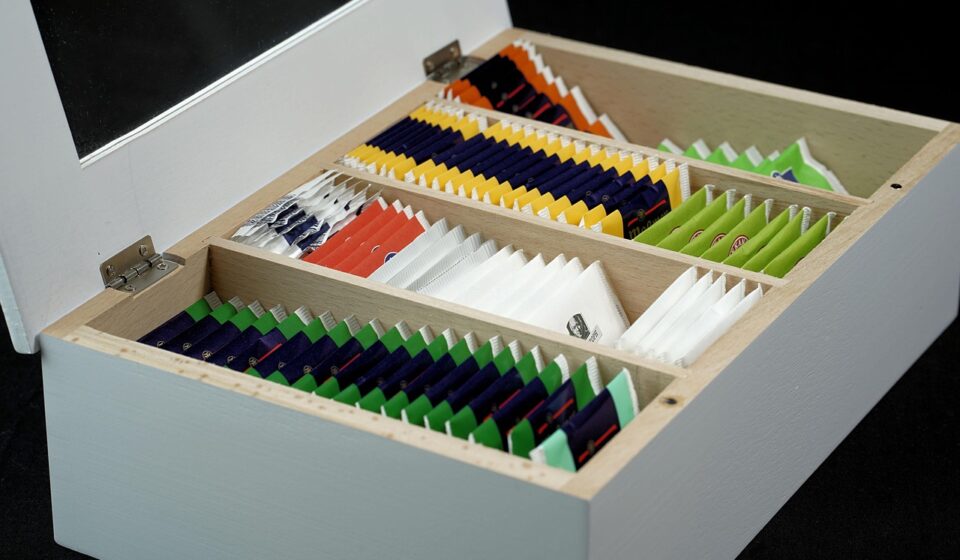
Gift tea packaging has a different role. It needs to feel organized, generous, and easy to navigate. A rigid box, drawer box, magnetic closure, or compartmented paperboard structure can help create perceived value. At the same time, gift packaging is often at risk of overpackaging. A strong brief should test whether each tray, wrap, sleeve, insert, or ribbon improves protection, reuse, navigation, or presentation. If it does not, it may add cost and waste without improving the user experience.
Choose materials with protection and end of life in mind
Paperboard remains a common choice for tea boxes because it prints well, folds efficiently, stacks neatly, and has a familiar recyclable appearance. The material decision, however, is not limited to the board itself. It also includes liners, coatings, windows, adhesives, inks, labels, and decorative finishes. A tea box may look paper-based while still containing plastic windows, metallized layers, laminated films, or coatings that can complicate recycling. Material choices should therefore be reviewed as a complete bill of materials.
Paperboard and folding cartons
Folding cartons are well suited to everyday tea ranges because they balance print area, shelf presence, machine packing, and transport efficiency. Solid bleached sulfate, folding boxboard, kraft board, and recycled paperboard can all be considered depending on brand positioning and food-contact requirements. For premium lines, thicker board, embossing, debossing, or textured paper can add a tactile cue, but these finishes should not reduce legibility or undermine recyclability claims.
Liners, inner bags, and windows
Freshness usually depends on the inner layer. Foil laminates, high-barrier films, coated papers, or tins may be used depending on shelf life targets and tea type. If a window is added to show the product, the design team should decide whether visibility is worth the trade-off in barrier performance and recycling complexity. A small window may help sell colorful herbal blends, but it is less useful when the product is already packed in opaque sachets.
Food-contact and certification checks
Even when the outer carton does not directly touch the tea, inks, coatings, adhesives, and inner components should be reviewed for the intended market and packing method. In the United States, the FDA explains that components of food packaging materials used in compliance with 21 CFR 174-179 generally need no further FDA review, and it specifically identifies paper and paperboard components under 21 CFR 176. (fda.gov) If the design uses forest-based certification claims, FSC states that chain of custody certification tracks certified materials through production and distribution and supports use of the FSC label on finished products when requirements are met. (fsc.org)
Build a retail-facing information hierarchy
Tea packaging often becomes harder to shop when every claim competes for attention. A strong tea box design uses a clear hierarchy: the front panel supports recognition, the side panels carry practical details, and the back panel builds trust. The front should not carry every detail. It should communicate the brand, tea type, flavor or origin, primary benefit or style, net weight or count where required, and one or two differentiating cues. Brewing instructions, ingredients, certifications, storage advice, and disposal guidance can sit on secondary panels where shoppers expect more detailed information.
| Box area | Main design job | Common mistake to avoid |
|---|---|---|
| Front panel | Brand recognition, tea type, flavor, key visual cue, quick shelf selection | Too many claims competing at the same size |
| Top panel | Visibility when displayed in trays, drawers, or stacked shelves | Leaving it blank when the box may be seen from above |
| Side panels | Flavor coding, count, barcode area, batch or regulatory information | Using decorative patterns that reduce scannability |
| Back panel | Brewing instructions, ingredients, storage, sustainability explanation | Making sustainability claims without explaining the condition or material |
| Inside flap | Brand detail, ritual message, reorder cue, QR support | Adding copy that does not improve the opening experience |
Color systems are especially important for tea ranges. Black, green, oolong, white, herbal, matcha, chai, and wellness blends need clear family recognition without becoming generic. A practical approach is to keep one stable brand block and use color, illustration, or typography to distinguish variants. This helps customers find repeat purchases while giving seasonal or limited editions enough room to stand apart.
Sustainability claims should be designed, not added at the end
Sustainability messaging is now part of the design structure. It should not be added as a badge after the box is finished. The claim must match the actual packaging system and the waste infrastructure of the target market. For example, a paperboard carton with a plastic window should not be described in the same way as a windowless mono-material carton. A compostable claim should specify whether the relevant component is home compostable or industrially compostable when that distinction is material to the consumer.
The regulatory direction also favors clearer design choices. Regulation (EU) 2025/40 requires packaging life cycle attention and sets a framework for design for recycling criteria, recyclability performance grades, labelling, waste prevention, and related measures. It also states that packaging may not be placed on the EU market from 1 January 2038 unless it is recyclable within specified grades A or B, subject to the regulation’s detailed provisions. (eur-lex.europa.eu) For design teams, the safer editorial principle is to avoid vague claims such as “eco friendly” unless the pack explains the specific material, certification, disposal route, or reduction achieved. See also: BUYING GUIDES.
There is also a commercial reason to be precise. Mintel has reported that 43% of U.S. consumers think coffee and tea brands should prioritize sustainable packaging, according to its tea bag sustainability analysis. (mintel.com) That does not mean every shopper will pay more or understand every material claim. It means packaging should make responsible choices easy to recognize without asking customers to decode technical language at the shelf.
Structural choices for shipping, opening, and reuse
A tea box is handled more often than many design briefs assume. It may move from converter to packer, warehouse, retailer, shelf, shopper basket, kitchen cabinet, and recycling stream. Structural design should therefore address compression strength, closure integrity, opening behavior, and storage convenience. A carton that tears on first opening or spills sachets in a cupboard weakens the brand experience, even when the print design is attractive.
For ecommerce, the tea box may need more corner protection or a snug secondary mailer. Oversized gift boxes can arrive damaged if the insert does not hold products firmly. For subscription packs, repeat opening matters because customers may keep the box for several weeks. For retail cartons, shelf-ready display compatibility can be as important as the individual box. Design teams should test how the pack looks in a row, in a tray, and in a partially depleted display.
Reuse should be treated honestly. A rigid tea box can be designed for reuse if it is durable, attractive after labels are removed, and useful for storing sachets or accessories. A thin folding carton should not rely on a reuse story unless the structure realistically supports it. Reuse is most credible when the design has a second-life function built in, such as a drawer format, refillable inner system, or organized compartment layout.
A practical checklist for a tea box design brief
Before artwork begins, packaging teams can reduce redesign work by turning the brief into a decision checklist. The goal is to connect brand strategy, product protection, production limits, and compliance review early.
- Product format: Define whether the box holds loose leaf tea, unwrapped bags, wrapped sachets, tins, samples, or mixed gifts.
- Freshness system: Identify which component provides the barrier against moisture, oxygen, light, and odor.
- Sales channel: Confirm whether the pack is designed for grocery shelves, specialty retail, ecommerce, gifting, hospitality, or subscription delivery.
- Information hierarchy: Decide the top three messages for the front panel and move secondary details to side or back panels.
- Material plan: List board grade, coatings, liners, windows, labels, inks, adhesives, and decorative finishes.
- End-of-life message: Write disposal or recycling guidance only after the complete material structure is known.
- Certification review: Confirm whether any FSC, compostability, recycled-content, or food-contact claim is supported by documentation.
- Usability test: Check opening, reclosing, dispensing, storage, shelf display, shipping, and barcode scanning.
- Range system: Create rules for color, typography, icons, and imagery so future flavors can be added without redesigning the brand.
For more packaging structure and visual communication topics, see the box design category.
Frequently asked questions
What makes tea box design different from other food packaging?
Tea boxes must communicate flavor, origin, ritual, and quality while supporting freshness. Because tea is sensitive to moisture, oxygen, light, and odors, the box has to work with the inner barrier pack rather than simply act as a decorative carton.
Is paperboard enough to protect tea?
Usually, paperboard alone is not the main freshness barrier for longer shelf life. It is valuable for structure, branding, print, and shelf presentation, but loose tea or unwrapped bags often need an inner pouch, liner, wrap, or other barrier component.
Should a tea box include a window?
A window can help shoppers see colorful blends, but it may reduce barrier performance and add material complexity. It is most useful when product visibility directly improves buying confidence and when the material choice is compatible with the brand’s end-of-life claims.
How can sustainable tea packaging avoid vague claims?
Use specific language. Instead of relying on broad phrases, identify the material, certification, recycled content, composting condition, or disposal instruction. The claim should apply to the actual component being discussed, not to the package as a whole unless every relevant part supports it.
What should appear on the front of a tea box?
The front panel should quickly show the brand, tea type, flavor or variety, key visual cue, and the most important product distinction. Brewing details, ingredients, storage advice, and extended sustainability explanations are usually easier to read on the back or side panels.