How to choose egg packaging materials for cartons, trays and cases

Egg packaging materials have to do more than hold eggs
Choosing egg packaging materials is a risk-management decision. A carton, tray or case must protect fragile shells, support handling and storage, provide space for required labeling, and fit the recycling or disposal systems in the market where the eggs are sold. Molded pulp, paperboard, clear PET, polystyrene foam and corrugated fiber cases can all work in the right setting, but no material is automatically the best choice for every egg brand or supply chain.
Guidance from the Food and Agriculture Organization notes that egg packaging should be clean and odorless, withstand handling and transport, help protect eggs from deterioration caused by temperature and humidity, and allow buyers to recognize or inspect the product. U.S. FDA food-contact rules, USDA Agricultural Marketing Service labeling guidance, EPA recycling guidance, ISO packaging standards and the EU Packaging and Packaging Waste Regulation all reinforce the same practical point: material choice should be specified and documented, not treated as a design preference.
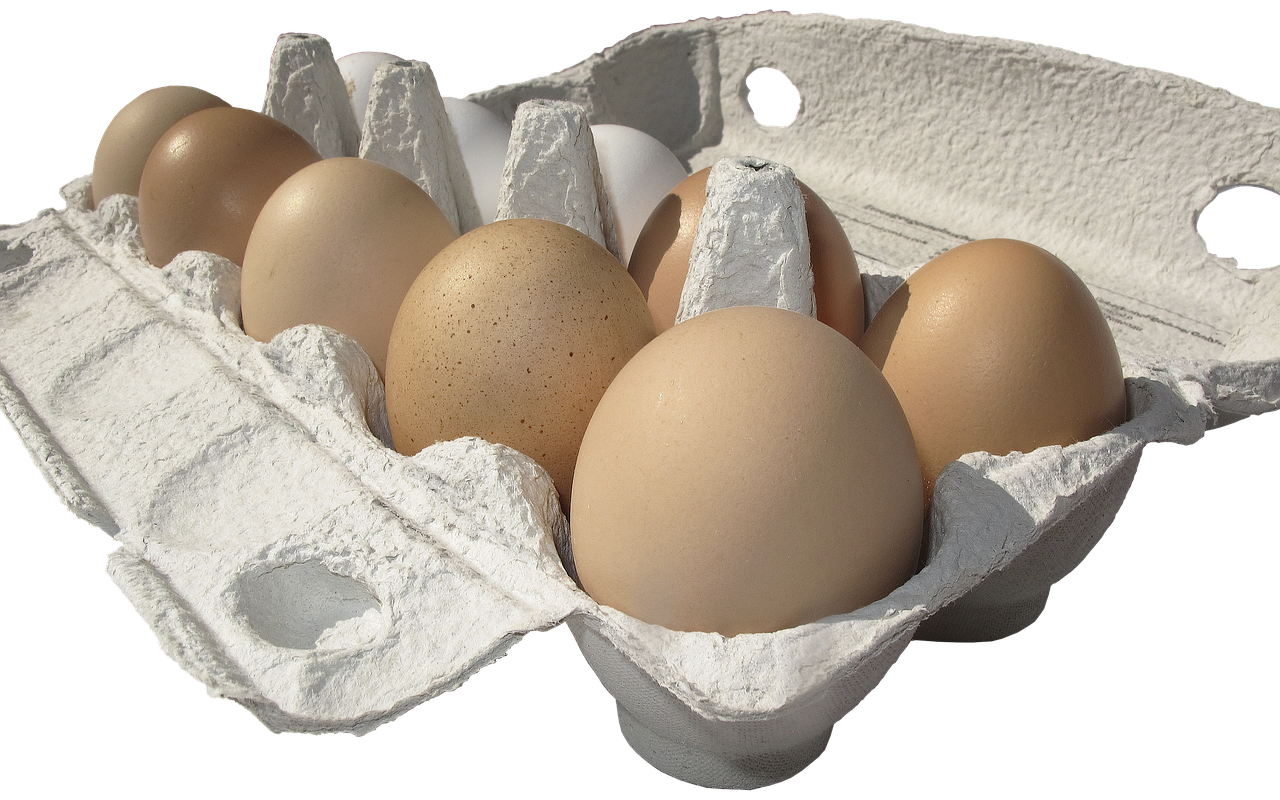
For more articles on packaging formats and material selection, visit the Packaging Materials section.
Main egg packaging materials compared
Egg packaging is usually designed in three functional layers: the direct retail pack, the filler tray or flat used for larger counts, and the outer shipping case. A retail egg carton may carry six, 12 or 18 eggs in many markets, while flats and trays are common for institutional and bulk handling. USDA volume-buyer guidance notes that U.S. retail eggs are often packed in dozen or 18-egg cartons or on 30-egg flats, while institutional eggs are commonly packed loose on filler flats in 15-dozen or 30-dozen cases. FAO materials also describe 36-egg trays as a common tray format, showing that pack counts vary by region and channel.
| Material | Common use | Strengths | Limitations | Typical decision point |
|---|---|---|---|---|
| Molded pulp or molded fiber | Retail cartons, trays and flats | Good cushioning, familiar paper-based appearance, often made with recycled fiber | Can absorb moisture, may lose strength when wet, limited transparency | Useful when cushioning, paper-based branding and local paper recovery or composting routes matter |
| Paperboard | Printed retail cartons and sleeves | Strong print surface, lightweight, familiar in grocery packaging | May need coatings or film for moisture resistance, which can affect recycling | Useful when shelf communication and print quality are priorities |
| Clear PET or other rigid plastic | Retail cartons, lids and washable fillers | Visibility, moisture resistance, dimensional consistency and possible reuse in some handling systems | Consumer perception and local recycling acceptance vary; food-contact status must be verified | Useful when visual inspection and moisture resistance are important |
| Polystyrene foam | Retail cartons in some markets | Cushioning, low weight, moisture resistance and odor protection | Limited curbside recycling acceptance in many places and increasing policy pressure | Useful only where allowed, accepted by customers and supported by disposal or take-back routes |
| Corrugated fiberboard | Outer shipping cases | Stack strength, pallet stability, printability and broad recycling infrastructure | Needs proper board grade, case design and moisture management | Essential for distribution cases and bulk movement |
This comparison shows why selection should start with the package’s function. A clear plastic retail carton may reduce handling because shoppers can inspect eggs without opening the pack. A molded pulp tray may be suitable where cushioning and low-cost bulk transport are priorities. In a long distribution chain, the corrugated case may be the most important breakage-control component, even though consumers never see it.
Protection requirements come before appearance
Eggs are sensitive to combined stresses. A pack may look acceptable during a quick inspection but still fail during stacking, vibration, hand loading, cold-room condensation or last-mile delivery. The first specification should therefore describe the actual route: farm to local retailer, regional distribution center, foodservice buyer, export shipment or online grocery delivery.
Before committing to a material, packaging teams should answer several performance questions:
- Does the cell geometry fit the egg sizes? A carton designed for one weight class may allow excessive movement if smaller eggs are packed inside, or create pressure points if larger eggs are forced into the cells.
- Can the material absorb shock without transferring it directly to the shell? Molded fiber and foam are often selected for cushioning, but geometry, wall thickness and lid closure matter as much as the raw material.
- Will the package remain strong under humidity? Pulp and paperboard can be affected by moisture, especially in refrigerated environments with condensation. Coatings may improve performance, but they can also complicate recyclability claims.
- Can the outer case carry the stack load? USDA guidance for volume buyers states that cartons, cases or other packaging materials should be the proper size and strength to keep breakage to a minimum, and that packaging must have sufficient strength and durability to protect the eggs.
- Does the design reduce unnecessary egg handling? Clear lids or windows can support inspection, but openings and film combinations should still be assessed for durability and recovery.
For producers and packers, the useful test is not whether a carton feels sturdy on a desk. It is whether the filled pack survives the intended route with the specified egg size, closure method, case count, pallet pattern, refrigeration conditions and handling practices.
Food-contact compliance should be checked by component
Because egg cartons and trays are used to pack, hold and transport food, food-contact suitability cannot be assumed from the material name alone. The U.S. FDA explains that components of food-contact articles may be authorized through several routes, including applicable indirect additive regulations in 21 CFR parts 174 to 179, GRAS status, prior sanctions, threshold of regulation exemptions or effective Food Contact Substance Notifications. FDA guidance also notes that a buyer may ask a manufacturer for a letter of guaranty for the intended food-contact use.
For egg packaging, procurement teams should request documentation for the full construction, not only the base material. In a molded pulp carton, relevant inputs may include recycled fiber controls, additives, colorants, processing aids, surface treatments and inks. In a plastic carton, the resin, colorant, regrind or recycled-content source, processing aids and any labels or adhesives may be relevant. In a printed paperboard carton, coatings and inks need attention because they may affect both food-contact status and recycling outcomes.
Labels also have compliance implications. USDA Agricultural Marketing Service import guidance states that shell egg cartons imported into the United States must carry English labeling that includes product name, country of origin, quality or description including date of pack, refrigeration wording, business identification and quantity. Shipping cases also require clear identifying information. Domestic requirements vary by program and state, but the packaging takeaway is consistent: the carton must provide enough printable or labelable area for legally required information without making the pack confusing or misleading.
Packaging buyers should therefore include food-contact compliance, label space and traceability in the material specification. A low-cost carton that cannot support required marks, batch codes, refrigeration statements or retailer information may create later costs through relabeling, rejected shipments or extra manual handling.
Sustainability claims need local evidence
Egg packaging is often judged quickly by appearance. Molded pulp looks recyclable or compostable, plastic looks recyclable if it carries a resin code, and foam is often assumed to be wasteful. These impressions are not enough for responsible packaging claims. Recovery depends on local collection rules, contamination limits, sorting infrastructure and whether the material is accepted in practice.
EPA recycling guidance for the United States says some egg cartons are recyclable cardboard containers, but it also emphasizes local-program variation. The same guidance notes that very few localities accept polystyrene foam in curbside recycling and that resin identification symbols do not automatically mean a plastic item is accepted by a community recycling program. EPA also warns that compostable plastics are not intended for conventional recycling and can disrupt recycling streams if mixed with non-compostable plastics.
ISO 18604:2013 is useful because it treats material recycling as a performance requirement rather than a marketing phrase. The standard, confirmed current by ISO in 2024, specifies requirements for packaging to be classified as recoverable through material recycling while recognizing that packaging recovery technologies continue to develop. For egg packaging, recyclability should be evaluated against the actual material combination, not only the headline material.
The EU Packaging and Packaging Waste Regulation adds another reason to document material decisions. As of September 2026, the regulation has begun to apply in the European Union and sets a direction toward recyclable packaging by 2030, higher recycled-content requirements for plastic packaging in 2030 and 2040, clearer sorting information and restrictions affecting certain substances in food-contact packaging. Egg packaging sold into or connected with the EU market should therefore be reviewed for design-for-recycling, material composition records, empty-space reduction, labeling and producer-responsibility obligations. See also: BOX DESIGN.
The wording of sustainability claims matters. A molded pulp carton may be a strong sustainability choice where clean fiber cartons are accepted in paper recycling or composting systems. It may be a weaker claim where food contamination, wet-strength additives or local rejection rules prevent recovery. A clear PET carton may be defensible where food-contact recycled content is authorized and PET thermoforms are collected and recycled locally. Foam may provide protection, but it needs a realistic end-of-life plan because curbside recycling access is limited in many markets.
How to match material to the sales channel
Local retail and farmers’ markets
For short routes and direct sales, molded pulp and paperboard cartons are often practical because they offer cushioning, a familiar natural appearance and easy labeling. The main risks are reuse hygiene, odor absorption and moisture damage. FAO guidance says reusable egg packaging must be checked for damage, odors and cleanliness. For small sellers, clean new packaging is usually simpler than managing used cartons unless local rules and sanitation practices clearly allow reuse.
Grocery shelves
Grocery packaging needs shelf communication, barcode placement, grade or size information, refrigeration instructions and stack stability. Paperboard offers strong print quality, molded pulp supports a tactile low-waste image, and clear PET lets shoppers inspect eggs with less opening of cartons. The choice should reflect retailer expectations as well as consumer behavior. A pack that invites repeated opening can increase breakage, while a pack that hides the product may frustrate shoppers in categories where visual inspection is common.
Foodservice and institutional buyers
For restaurants, bakeries and institutions, packaging efficiency often matters more than retail appearance. Filler flats, trays and corrugated cases should be specified for count accuracy, case strength, pallet pattern and ease of handling in cold storage. The carton’s marketing surface is less important than breakage control, lot identification and speed of receiving.
E-commerce and last-mile delivery
Online grocery delivery exposes eggs to extra handling events. A retail carton that works in a controlled grocery case may need secondary cushioning, case separation or stronger closure for delivery routes. Material choice should be tested with the actual pick-pack process, tote system and vehicle conditions. For e-commerce, the best-performing design may be a combination of retail carton, divider and outer case rather than a single premium carton.
Export and regulated distribution
Export packaging requires a conservative approach. In addition to material performance, buyers should confirm import labeling, food-contact documentation, refrigeration statements, country-of-origin information and case identification. If the destination market is the United States, USDA AMS import guidance specifically highlights English labeling and refrigeration wording for shell egg cartons and shipping cases. If the destination is the European Union, packaging teams should review PPWR-related obligations and food-contact material rules before finalizing resin, fiber, coating and labeling choices.
A practical selection checklist
Before approving an egg carton, tray or case, packaging teams can use the following checklist to turn material selection into a documented decision:
- Define the channel, transport distance, storage temperature, pallet pattern and expected handling events.
- Confirm egg size range, cell fit, closure strength and whether consumers or buyers need product visibility.
- Request food-contact documentation for fibers, resins, additives, coatings, inks, labels and adhesives.
- Check required label content for the destination market, including grade, size, quantity, pack date, refrigeration wording and country-of-origin statements where applicable.
- Test compression, vibration, drop resistance, moisture exposure and cold-chain performance with filled packs, not empty samples.
- Verify local recycling, composting or take-back acceptance before making environmental claims.
- Record material weight, recycled content, coatings, print systems and supplier declarations for future audits or regulatory updates.
This process helps avoid a common packaging mistake: choosing a carton because it looks sustainable, premium or low-cost before proving that it protects eggs, complies with food-contact rules and can be recovered in the markets where it will be used.
Frequently asked questions
What is the most common material for egg cartons?
Molded pulp or molded fiber is widely used for egg cartons and trays, especially where cushioning, paper-based appearance and cost efficiency are important. Paperboard, clear rigid plastic and polystyrene foam are also used, depending on market requirements, visibility needs, moisture conditions and local regulations.
Are molded pulp egg cartons recyclable?
They may be recyclable where local paper programs accept clean molded fiber, but acceptance is not universal. Some programs prefer composting or disposal if fibers are too short, wet, contaminated or treated. A recycling claim should be based on local collection and processing rules, not only on the fact that the carton is paper-based.
Is plastic egg packaging always less sustainable?
No. Plastic packaging can provide visibility, moisture resistance and precise forming, and some plastic formats may use recycled content where food-contact rules allow it. However, recyclability depends on the resin, color, labels, local collection systems and sorting infrastructure. Sustainability should be assessed across protection, material weight, recovery and compliance.
Why do egg packages need ventilation or breathability?
FAO guidance notes that eggs need appropriate packaging conditions and that packaging should be clean, odorless and suitable for storage and transport. In practical terms, egg packaging should avoid trapping odors or moisture in ways that could affect quality, while still protecting shells from shock and pressure.
What should buyers ask suppliers before ordering egg packaging?
Buyers should ask for material specifications, food-contact compliance documentation, recycled-content information if claimed, ink and coating details, test results for strength and transport conditions, label-area drawings, and end-of-life guidance for the intended market. These records are especially important for regulated retail, export and private-label programs.